The following is the opening chapter of Eating Malawi, a book about Malawian food and its people.
1
Alone
It was still early, the vacuous house inundated from last night’s thunderous storm of words, stood ever so silent. I packed my red rucksack with whatever clothes laid about, a few gadgets, a few toiletries, a map of the country, a Chichewa language guide for tourists, a tape recorder, clean notebook and a few pens. The morning light was hazed with tears, the air kept finding ways to escape my lungs, the only consistency that existed anymore was that nothing was clear. Not the past, not the present, and most of all not what laid ahead. With that, I tied on a pair of hiking boots, put on a hat, and walked out the door.
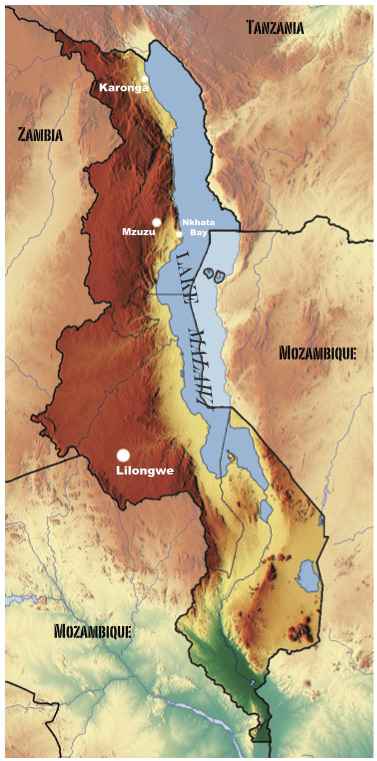
The first leg of this journey, I decided while trying my best to ignore the fact I had yet to figure a definite purpose for such journey, would begin in the North Region; in the small town of Karonga, about ninety kilometres from the north tip of the country. It would be an exploration of Malawian culture through its food, I said to the editor in my head; an investigation of what people eat in a country that is internationally famed for poor nutrition. I would uncover the pot of authentic Malawian fare, yes, it would be a most rewarding adventure. The editor stared at me, blankly.
As I made my way across Area 3 in the Malawian capital, Lilongwe, towards the bus depot, the walk itself verged on losing purpose and becoming an awkward stroll around the neighborhood with a giant bag strapped to my back. Only the certainty that I needed to get out of Lilongwe kept me walking: I wished to get lost in an adventure, to run away from the sadness of what seemed an inevitable break- up, to make something out of myself in the remoteness of this African country of which I knew so little but had invested so much to make it my home. A handful of men are always at the entrance of the bus depot waiting for disoriented travellers to stumble in. Their job, they’ll say, is to guide passengers to the correct bus, and since no one pays them for their valuable services, one is in the moral obligation, which they are keen to stress, to tip them, even when their guidance results in going into the wrong bus. As a foreigner, or musungu, it is absolutely inevitable to avoid them, but in my experience, one is better off picking one guy and letting him become one’s official guide and representative instead of trying to ignore the lot or allowing them all to pitch in with their “assistance”. It also helps to walk in with a general attitude of defeated disdain, which, luckily, I was emanating from every pore.
Soon enough I was sitting in a semi-crowded bus, ready to be surrounded by strangers and lulled by the romance that all long bus journeys evoke: a passing view of the world as one leaves the past behind and can be alone with one’s thoughts. Only, this time it was my thoughts I was trying to get away from, and so for a time, as the bus kept filling with people, I wondered if my sanity could endure a six-hour ride with nothing but the rolling hills of Malawi in the background of a growing mental darkness and solitude.
From Lilongwe to Mzuzu, the third largest city, I sat next to a man with no fingernails on his left hand. We spent most of the journey in silence, him looking out the window, me imitating him, pretending I wasn’t being smashed, leaned and bumped on by the crowd of people who sustained the journey standing in the aisle of the bus. When we finally reached the tall forests of pine trees in the outskirts of Mzuzu — a view that in previous trips I’d treasured both for the beauty of deep forests in this vastly barren land, and because it meant we were close to reaching our destination —I looked down at my companion’s peculiar hand and, realizing the trip would soon be over, I was taken aback by the thought of carrying on without this odd hand beside me in my life. Suddenly, I was fighting back tears, and even as I reasoned the utter irrationality of my feelings towards this man, I could not rip off the nostalgia pressing on my chest. Had I known what it meant; to be so sad upon the departure of someone I did not know in the precise moment when I was stepping into a journey of solitude, I might have clinged on to him, might have stayed sitting on that same seat until the next day when the bus drove back to Lilongwe, and would have, almost certainly, failed to work up the courage to continue and thus to find anything akin to the independence that comes from getting to know oneself in the world.
At the bus depot in Mzuzu, the man with no fingernails and I said goodbye like two people who’ve sat together in an uneventful six-hour ride. “Good-bye”. The idea of getting on another four-hour bus to Karonga, where I was to begin my exploration, seemed impossible, both because it was already too late in the afternoon and because I was incapable of facing another parting of ways with a stranger. I decided to skip over to Nkhata Bay – only an hour east and conveniently equipped with a calming lake breeze, relaxed atmosphere, and friends who would have no choice but to lend me their couch and listen to my emotional rant until late hours in the night.
By 7am the next morning I was in a shared taxi with a mild hangover, on my way back to Mzuzu. Buses in Malawi, like its people, are not guided by schedules. The bus leaves when it is not humanly possible to fit another soul, thus getting into a comfortably empty bus is usually a sign of a long wait. How fortunate, then, that upon reaching the depot after a heavenly comfortable taxi ride, I came face to face with a packed minibus leaving for Karonga. Just when I thought the day could not get any better, I was allocated a seat in the driver’s cabin, a blessed luxury for anyone who knows the pains of sharing the back seat of a minibus, often with five other people, their luggage and the classic gargantuan sack of odorous sardines.
Karonga is the first official stop into Malawi from Tanzania. Tourists will find a few supermarkets, a bank and a couple of hotels, but the main and most unusual attraction in this otherwise non-descript town is the Cultural & Museum Centre of Karonga. Malawi, a country famous for its dearth of infrastructure, is not abundant in museums; the few buildings that display its mostly unrecorded history stand in major cities. As such, the unlikely location of the Karonga Museum is due to the fact that its most important treasure was found in the area: a skeleton of the famous Malawisaurous, a genus of the titanosaurid family, which is of course a big, big dinosaur.
Try as I might, the inclusion of dinosaurs in an investigation about food was an improbable prospect. My visit to Karonga was motivated by rice fields, as I had been told this northern area, particularly around the overflow of the North Rukuru River, was the origin of some of the best rice in Malawi. Rice, the second most cultivated crop in the world behind maize, is believed to be originally from China, though it quickly spread to South and Southeast Asia, where it was appropriated as a staple food before it continued its expansion to the Middle East. Rice entered East Africa through Arab traders around 1000 BC. It was a favourite staple food in the Arabic and Swahili communities of Zanzibar and Tanzania.
In Karonga, just under one thousand kilometres from Tanzania’s biggest port, the cultivation of rice dates back to before the arrival of the British, when it was the stronghold of an Arab slaver. Of those murky times no trace remains, except a tradition to cultivate the white grain. I sat in the front seat and eagerly watched the north come closer. Not thirty minutes into our ride, we stopped at a road junction near a small town called Ekwendeni, where a couple of passengers got out and a woman wearing a fashionable black and white dress and modest heels got on. She had tight braids drawing straight lines through her head, ending in a tall ponytail. Eyeliner traced her brown eyes, and a slightly glimmering eye-shadow reached the meticulously shaped slivers of her eyebrows. Although her attire separated her from other women in the minibus, who, like most women in rural Malawi wore colorful fabrics over their waists known as chitenjis, what truly made her stand out was intangible; there was authority in her manner, the kind found in people whose accomplishments are their own.
Her name was Rose Mwalwanda, she came to sit between the driver and I as soon as a spot opened; she didn’t have to ask, it was simply her place to be in the front seat. I felt like a dirty child in old rags as I sat there, inhaling her soft fragrance of floral soap; one of us had managed a shower that morning, not the driver, and certainly not me.
Rose was originally from a village in the outskirts of Karonga, though she now lived in the town of Ekwendeni with her two young daughters, Khumbo and Aleluya. She was a business woman, she said, and she was on a business trip to Tanzania. Rose had, in fact, a plethora of businesses, I would come to find, and buying clothes in Tanzania to resell them in Ekwendeni was only one of the many small enterprises that paid for her children’s schooling and her own, as she was completing a degree in a technical university in Mzuzu. Her husband, she told me in passing, was working in South Africa.
We talked throughout the journey, at times she stopped to translate for the driver, who discreetly leaned his ear towards Rose and kept his eyes on the road while she filled him in on what this musungu was saying. I told Rose I was setting out to travel through to learn about the foods that are grown and eaten in different areas of Malawi. She took a pause and then proceeded with an explanation on everything she knew about crops in Karonga.
Karonga, she began, is where most of the rice comes from. Everyone who could grew rice to sell; it was the cash crop of choice in the area. Karonga’s rice is famed for its distinct flavor and aroma. There was no such thing as irrigation systems in the north — in fact most of Malawi lacks ways of keeping its crops consistently moist — so farmers relied on rain to nurture their fields. By April, when the sky had drained the last drops of the rainy season, the people of Karonga took their harvest and formed long queues at local mills. In the old days, before mills were commonplace, rice farmers dried the grains in the sun and then pounded off the husks themselves. Some people who could not afford to lose money to the mill still pounded their own rice before taking it to the local market, where traders from across the country awaited.
Despite the abundance of rice, the people of Karonga only ate it on special occasions. Their day-to-day meal, like that of all Malawians, revolved around nsima. Throughout Africa, this food has as many names as there are countries, yet there is little variation in the recipe: refined maize flour cooked in water to form a firm porridge that is dipped in a variety of relishes.
Of course people in Karonga ate rice, Rose assured me, but not more so than nsima, after all, “nsima is the staple food of Malawians”, she explained, her words condemned with tradition, repeated to me as they had been repeated to her all of her life. Rice was reserved for special occasions, not because it was thought to taste better than nsima, but because it was more expensive and farmers could not allow their families to consume the cash crop if they were to make any money.
The scenery in the north country is, even in the dry season, an inspiring view of patched green land with round hills and scattered mango trees. Rose pointed out the names of the areas we passed, which I repeated out loud and then instantly forgot, and explained what crops grew in each area. Whenever she wasn’t sure about something, she would consult with the driver and the passengers behind us, and they would debate loudly amongst themselves in Chinkhonde, the language of the far north. It seemed to me that Rose always won the debates, but perhaps it was that she was louder than everyone else. The only thing they all adamantly agreed on, was the importance of cassava as a staple food in the North Region.
Cassava, which, as a Latin American I knew under the name of yuca, is a root that originated in Brazil and was first cultivated in Central America. Like maize, cassava was introduced to East Africa by the Portuguese sometime between 1500 and 1700. The plant’s little need for irrigation and fertilizer, coupled with the heavily starched root it produces, made it a popular crop in Africa during times of drought and hunger. Nowadays the largest producer of cassava in the world is Nigeria, and countries across the continent have developed a plethora of dishes that feature cassava. In Malawi, cassava is mostly consumed in the shape of nsima, and mostly in the North Region.
At one stop, the driver bought a bundle of cassava from a street vendor. It was a type that could be eaten fresh by peeling the outer hard layer, Rose explained. He offered some to Rose and myself, and as I chewed my first bite of the brightly white root I felt all eyes on me, waiting for a verdict. “It’s good, thank you very much,” I said to the driver, and everyone let out a relieved laugh. The musungu approves, the musungu likes cassava. It tasted just like one would expect a juicy, uncooked root to taste, and in a different situation I might have taken one more bite before concluding this was not a food to be eaten raw, but I was being eagerly welcomed into this insight of Malawian culture, I couldn’t let my foreign palate get in the way. Slowly, I chewed and swallowed the whole thing.
When we were closer to our destination, I asked Rose if she could recommend somewhere to stay in Karonga; the Lonely Planet guide I had only listed a few expensive options. She debated with the group again, and then turned to me and said she would show me everything I wanted to see when we got to town.
At Karonga, she waited until we had rested a while from the journey at the bus depot, and then explained she had planned to stop at her village to visit her family before continuing her journey to Tanzania the next morning, and I was welcomed to come along and stay with her, she could show me the fields where people grew rice in the area, and perhaps I would also be interested in visiting fields of other crops, she offered. Overwhelmed by her generosity, I thanked her and accepted her invitation, and yet, as we walked out of the bus depot into Karonga, a rush of insecurity came over me: here I was, following a stranger into some unknown place without the slightest clue of where I was or what I was doing. Perhaps I was the kind of person who follows strangers into unknown places; I just couldn’t remember there and then who I was anymore; it seemed the very few things around me that were familiar belonged to the life I had been living for the past year, the life that was on the verge of an emotional abyss, the one I was holding responsible for me not knowing who I was anymore. The person who grew up in the high Andes of Ecuador, the one who spoke Spanish, who had a marginal experience in using public transportation to move across unknown countries and whose staple food was bread, that person would have not likely followed a stranger into an unknown place, but then that person was not there.
I would follow Rose, I decided, but before I did I would have to shake off the irrational fear that was making me feel like a child who has suddenly realized she’s lost her parents in the middle of a crowd. I would go to visit the Cultural & Museum Centre of Karonga for a little while, I said to Rose, before heading to her village. Other people might have objected to that plan, but Rose was not one to be troubled by other people’s foolishness. She instructed a bicycle driver to take me to the museum and gave me her phone number to arrange meeting later.
There were more spider webs than exhibition cases at the Cultural & Museum Centre of Karonga. My guide — also the receptionist and cashier — was a softly-spoken man who had the delicate mannerisms of someone who prefers words to tools. His name was Wilson Hara, he asked for my email address before I left; it was museum policy, he said, but mostly he liked keeping in touch with foreign friends. He would give me a guided tour, he said matter-of-fact, and since there seemed little danger of any other visitor walking in and finding an empty reception, I was unable to decline. His eyes were covered with cataracts; though he was not blind, it seemed his sight had whittled down to shadows. And so, as he began his rehearsed speech in the meticulous order in which he’d practiced it, I felt it would have been insensitive to ask him to skip the display about birds of Malawi, to speed through the explanation on the evolution of homo sapiens, and to just show me the blessed dinosaur already.
In 1928 a South African paleontologist by the name of Sidney Haughton was brushing dust in Nyasaland when he discovered the fossil bones of a new kind of tyrannosaurus. Then, it seems, everyone forgot about the matter and in 1993 an American paleontologist ‘discovered’ these same bones and came up with a name for this type of long-neck: Malawisaurus. Other foreign experts have found bits of pre-human bones that have led to hypothesize that this area could be the very cradle of human life on Earth. As this theory is yet to be proven, Karonga’s consolation prize is a cute building donated by the EU to house a pink dinosaur skeleton.
It’s a known fact – apparently, I’m still quite shocked – that museums seldom display real fossils; they wouldn’t want to drill holes on them in order to hang up the displays. Yet in most museums around the world the bones look quite convincing.
Not in Karonga. These plaster cast bones, explained Wilson, were modeled in Canada after the real bones, which, he assured me, were sent back to Malawi in the same shipment alongside the fake skeleton. Now, I’m not going to sit here and judge the commitment of Canadian artists, but maybe I am. Couldn’t they make bones that were not so obviously pale-pink, toy-looking fake?
I was glad to have Wilson’s company in the vacuous building, where our voices echoed like faraway thunder, making the spiders cringe. Nothing about his explanations of the displays, however, was particularly revealing. Not until we reached the Malawisaurus. Wilson was telling me about the difference between old and new bones; on the sand box where the Malawisaurus toy was propped there was an elephant’s skull that served as an example of a ‘fresh’ bone. “This one,” he said, bending down and slapping a grey stone that was casually sitting next to the skull, “is the actual fossil of the dinosaur.”
Rose’s village was five kilometres north of town . She recommended I get a bicycle taxi and asked to be put on the phone to the driver so she could give him directions. In Malawi bicycle taxis are as common as motorized ones elsewhere in the world; there are registered cooperatives in all cities and less organised groups in smaller towns, all of which adhere to similar standards and rates. A bicycle taxi consists of a small rectangular seat cushion that is strapped above the rear wheel of a regular manual bicycle; as a customer, one’s job is to hold still so the driver may keep balance while he pedals. Women who use these services usually sit with both legs to one side of the wheel, most lady-like. Well, Malawian women, that is, foreign women such as myself who have no idea how to keep balance on the back of a bicycle while keeping a lady-like pose, are encouraged to sit like the men, with one leg on each side, and instructed to hold on to the handles fitted —exclusively for clumsy foreigners, I’m sure — between the driver and passenger seat. Not all bicycle taxis have these helpful handles, which, especially in rocky terrain, results in the embarrassing scenario of clumsy foreigners holding on to the driver for dear life.
Awkward as it may seem to strike conversation while you hug the back of a stranger, it is, I assure you, more uncomfortable still to ride in silence while passersby stare in disbelief. Turns out the athletic young man spoke a little English aside from Chichewa — both are official languages in Malawi —as well as Chinkonde and a bit of Swahili. His dream was to live across the border, in Tanzania, where, he said, there were more job opportunities and things were generally better.
I was well into a speech on patriotism and the difficulties of living in foreign countries when we reached a police road-block. The boy swayed to the left and parked; this was my destination, he declared. I looked around at the few vegetable vendors on the side of the road, at the police officers sitting on their official plastic chairs, and at the tall grass fields that surrounded us all. Eventually a girl stood up from the crowd of vendors staring at me, and gestured to follow her; she spoke no English, so the bicycle driver translated: she was Rose’s niece and she would take me to see Rose. She insisted on carrying my giant rucksack, which, despite being almost as tall as her, seemed ever so light on her shoulders.
I had hoped my time at the museum would give Rose the opportunity to have lunch with her family without the awkward commitment of having to feed an unannounced guest. As the girl and I got closer to the collection of houses that form Kafikisira village, a group of little children ran out to meet us; it seemed Rose had let everyone know a musungu would be dropping by, which, judging by the amount of curious children walking around me, was not an everyday occurrence. Rose received me with a hug. She had wrapped a chitenji around her waist and exchanged the high hills for a pair of modest flat shoes. As I’d guessed, she had eaten lunch with her family, but not to worry, she said, she would have her niece-in-law, the one who had just carried my bag from the side of the road, prepare my lunch right away.
We were invited into the girl’s house as soon as she had lunch ready, which I was unable to convince Rose I did not need and unable to truly convey gratitude towards the girl for all of her hospitality, as I did not speak a word of Chinkhonde.
We stepped into the hut, which was divided into three small rooms of bare walls and dirt floors. One was a bedroom, which had a mattress on the floor, and another seemed to be a family room, with only a straw mat on the floor. Rose invited me to take a seat on the mat across from her while the girl brought out a plastic tray with an assortment of steaming bowls and plates. Under Rose’s silent supervision, as if being tested on a lesson she was supposed to have been practicing, the girl assisted me on washing my hands over a basin, a ritual that even in the most humble of homes in Malawi is essential before a meal, as Malawian food is commonly eaten with one’s hands.
One by one, she arranged the dishes on the mat between Rose and I: a relish of warm tomatoes and onions cooked in oil, a steaming pot of freshly-made maize nsima, and on the side, a bowl with two hard boiled eggs, a show of an extra effort to be welcoming and generous. It used to be, a few generations back, that eggs were very rarely eaten in villages. A survey of native food made in 1940 reported that the “general, very sound attitude is that the resulting fowl is more valuable than the egg”. There were, perhaps to reinforce such sound attitude, superstitious beliefs about eating eggs: it was said to result in impotency in men and give women difficulty during childbirth. Those days are long-gone; hard-boiled eggs were now a popular choice snack – my favourite – at bus depots, and Malawians of all socio- economic classes ate chicken eggs as much as Europeans, who back in colonial days used to be the only ones to consume them.
In another bowl the girl brought a small portion of masamba, green leaves chopped and boiled. These are usually from mustard, cassava or pumpkin plants, depending on the season, and are primordial in a typical Malawian meal. Yet the meal is always centered on nsima; that she had served maize nsima instead of cassava nsima further confirmed her intention to present me with the best food she had. Before I could compliment her cooking, she quietly retreated outside; it was her house, but Rose was the official host, and clearly had authority over her as a senior member of the family.
It was not the first time I had been served Malawian food; I had in fact tried to make nsima myself once or twice, and had failed to make anything edible. I also lacked any dexterity to eat with my hands, and would suffer through a few more meals before I learned to eat nsima without making a mess.
As I clumsily maneuvered balls of white mush and dipped them into the relish, Rose told me about her family. She had nine brothers and sisters, of whom the eldest was Susana. Her sister Susana had lived in the village all her life, she never learned to speak English, had never gone to school, and knew very little of the world outside Kafikirisa. There was an abysmal difference between Susana and Rose that seemed to exemplify two extremes of Malawian women; while Susana spoke only her maternal language and was draped in torn clothes, Rose, adorned with jewelry, had three languages to pick from and no qualms with starting conversations with foreigners. On plain sight, it would have been hard to guess they were related, and yet, it only took a couple of minutes of sitting with them and hearing them laugh the same laugh to realise they were dear sisters. Had Susana been given the opportunity to go to school and outgrow the village the way Rose had, I’m certain she would have been as talkative to me as her sister, but all we could do once I got to her home was smile at each other; she had a contagious smile.
Of the ten children, three died at an early age. Still, the family was too numerous to educate every child; the older ones stayed home to help with chores, and in time, when Mr Mwalwanda could afford it, the younger kids were sent to school. It was largely a family of women; only one of the sons was still alive; his name was Grant. He came to say hello, his house was next to Susana’s, who had rightfully inherited the family home where they all grew up. Grant, a school teacher, was a polygamist, a common practice amongst the Chinkhonde people as well as other tribes in the North Region. Although no one explained it to me in these words, it seemed there was an element of social stance in having more than one wife; after all, if one could provide for more than one family, surely that in itself was a sign of wealth. Grant had given each of his two wives her own house, one next to the other. His second wife was a police officer in town, she seemed nice when she came over to meet me, still, I couldn’t help but feel concerned for the first wife: no one wants a Malawian police officer as an adversary.
Rose, Grant, and one other sister who lived in Germany and was married to a Malawian diplomat had been given the advantage of education, which seemed to cause no quarrels between siblings. There was, however, an unspoken rule that governed the Mwalwanda family, much like it rules families across Malawi: those who get ahead in life are obliged by moral code to help their relatives financially and otherwise. As an Ecuadorian, these family values are not that far from my own, though it must be said the lines of this morality are drawn at a much more comfortable perimeter that allows for expanding inequality of wealth between siblings in Ecuadorian families.
After meeting the family and dropping my bag on Susana’s front porch, Rose and I took a stroll out to the fields. We passed a neighbor working on her cassava stash. Cassava nsima looks as plain as a lump of food can be, but there’s a substantial effort in making the flour for this two-ingredient recipe. Cassava roots are generally tough and need to be soaked in water for three or four days before they are soft enough to handle. Once soft, women throw the roots into their giant mortars — an essential home appliance found many a household in rural Malawi, — and pound them into small pieces. The bits are spread on mats and left to dry in the sun for a couple of days. One can easily guess where cassava is being dried; its pungent odor is as powerful as fermented roots can be. Anything that brushes against a piece of the chalk-like dried root is left with a trace of white dust and its corresponding lingering aroma. Once cooked into nsima, however, the flour loses its odor.
Rose exchanged pleasantries with the neighbor. The woman stopped her labour to chat and after they caught up with the latest news of each of their households, Rose asked her to show me what she was doing and explained in English the process her friend was reciting in Chinkhonde: she was pounding dried bits of cassava into flour and passing it through a sifter. It was the last step in the making of the flour that would feed her family for the season. Although it was clear by her swollen biceps and flushed face that this was not an easy job, she spoke with the light mood of someone who’s been picking flowers in the prairie, — albeit in a drizzle of white powder.
We left the neighbor to her chore and went to see where most people in the village grew their crops, near the North Rukuru River. Sweet potato, pumpkin, rice, maize, tomato and banana were all crops within our sight. I wondered why, with all the variety of food that grew in the area did women like that neighbor spend so much of their time in the production of nsima. There have been dozens of foreign initiatives —mostly from non-governmental organisations based in Europe and North America — in Malawi to teach and encourage people to expand their diet and pull away from the tradition of nsima, a food with little nutritious value. Nsima was eaten by most Malawians at lunch and dinner, Rose said as we looked out to the riverbank, some people even ate it for breakfast. What did I eat for breakfast, she asked. Why, bread, of course. Perhaps because I had never before lived in a country where bread was not the most common staple food, I had never noticed just how much I — and by extension most people I had grown up with and known —relied on bread products with the same insatiable need as Malawians rely on nsima. If a foreigner came to my country to ‘teach’ me to eat less bread, I thought, I’d throw a heavy scone at him.
Rose asked a lot of questions. She wanted to know about my family, my friends and my boyfriend. I tried to keep the answers simple because these were all sensitive topics; I badly needed to be around my friends and family again, more so when I thought about losing the only meaningful relationship I had in this continent, losing the love and friendship of the man who had my heart. She was a good listener and knew to interpret the pauses that kept my voice from cracking.
On our way back to the village, I spotted a most peculiar fruit hanging from a skinny tree. Dark green, heart-shaped and characterized by soft spikes on its leathery skin, soursop, or guanábana, as it’s known in Spanish, is native to Central America. Its white, custard-like flesh is moist and has a unique sweet-sour taste. I would have never thought to find this most Latin American fruit in the middle of Africa, but as I would come to find in my travels, there are many fruits from around the world growing unnoticed in Malawi. Commonly, guanábana is used in puddings, pastries and juices all throughout South and Central America, but here in Malawi, Rose explained, it was a fruit of minor importance, eaten occasionally straight from the tree and not part of any recipe she could think of.
A seemingly endless parade of relatives and neighbors stopped by at the Mwalwanda house that evening. Rose and her sisters sat on the floor of the porch waiting for the sun to sink over the horizon, and I sat with them, blankly listening to their conversation in Chinkhonde. It didn’t bother me that I didn’t understand their words, I could tell they were just catching up on the village gossip. Every person who stopped by wanted to be introduced to the musungu, or at least get a good look at me before asking Rose who I was. She unwearyingly repeated herself and translated our greetings, which were exchanged in front of an audience of about a dozen small children who seemed fascinated by my mere existence.
At dusk Rose instructed me to stay and rest on the porch while she went to meet a friend by the side of the road. She came back with Anita Moyo, a neighbor from Ekwendeni who would be joining her on the business trip to Tanzania. Anita looked like a city girl; she wore big golden hoops, fake long hair and a bright red dress. I suspected she didn’t understand Chinkonde either, but even in Chichewa she limited her answers to short, sharp remarks. I was glad to not be the only outsider, and even more glad to be the more amicable of the two.
That night Susana cooked a special meal for her guests. Without ceremony, she brought trays to a mat on the porch where we had been sitting. There were only three plates, however, and one soup spoon. Susana would not be joining us for dinner, nor would any other member of the family; in fact, the children who had been playing around us were shooed away and the rest of visitors dissipated. It had not always been like this in Kafikisira: it used to be that people in villages all across the land of the lake known today as Malawi sat together and brought whatever they had to share in communal meals. This tradition, known as chidyerano, was no longer practiced here. Instead, each family worried about feeding only its closest members, and even then there was a pecking order that could be mapped by noticing who got to eat rice (guests), who ate maize nsima (heads of families) and who ate cassava nsima (the rest).
We were served a steaming bowl of rice, accompanied by fish cooked whole and a sauce of tomato and onion on the side. Susana sat near Rose and spoke quietly to her loud sister while we ate. Eating rice with one’s hands was, to my amazement, an immaculate process for Rose and Anita. They each molded handfuls of grains into perfect dip-size balls, then scooped some of the relish and fish with it. Meanwhile, I chased bits of rice around my hand and down my wrist. The spoon that had been brought for me sat on the edge of the tray, laughing. I tried my best to ignore its presence while I cleared every grain of rice off my plate and proceeded to eat the fish leaving nothing but clean bones. The fish was a type of cichlid, which are known for their colourful variety and not often fished in great numbers. Malawi has the greatest diversity of cichlids in the world, many of the species are yet to be scientifically categorized. The one on my plate was gray and delicious; this kind of fish, known as vap in Chinkonde, had tender pinkish flesh that fell off its small frame. Neither of the women said anything about my most uncivilized table manners; as a musungu, I suppose, I would be pardoned just about anything.
The night ended with an impromptu photo session shyly requested by the teenagers and kids of the village. Their smiles filled my frame again and again. The only thing they liked more than having their picture taken was looking at it afterwards on the screen of the camera. Three women choreographed a chant, hoping to get their photo taken as they clapped and sang. I managed a couple of decent shots, but it was difficult to keep the children from jumping in front of the lens and crowding so tight around the women in smiling poses that only the top of their heads would bounce the light of the flash.
Once the euphoria dwindled down some, one of the singing girls pulled me out of the crowd and declared I was very tired and needed to rest. She took me by the hand back to the porch, where Grant had set up three mattresses and hung a mosquito net over one of them; this was to be my bed. The girl sat me on my bed, told the last of the curious children to leave, and then, with her elbows pressed on the mattress and her head resting on closed fists, she watched me tiddy my belongings. Timidly, she explained that her mother, whom she cared for, was very old and could no longer walk. Thus, she wanted me to stop by her house in the morning so she could meet me. I promised I would and with that I was finally left to fall asleep to the sound of Rose’s lively conversation with her family.
When I first moved to Malawi, the poverty for which this country is known escaped me. There was no desperation, no sadness in anyone’s face, and their good-humored manner to simply get on with their lives made me wrongly conclude the reports I had read were exaggerating. It wasn’t until I entered rural Malawi that I was hit in the face by endemic poverty. This inheritance, passed from generation to generation, is well distributed amongst those who have nothing but a faint idea of what they lack. I can say, in my experience, these are not people who yearn for comforts, but for opportunity.
The sun had yet to peek through the village huts when the brushing sound of a woman sweeping the dirt floor woke me up. Rose was lying next to me, and besides her, on the third mattress, was Anita. Perhaps in a different situation sleeping on the porch of a house would seem odd, but as I looked around nothing, not even me, looked out of place.
The three of us took turns to use the bathroom, which consisted of a low brick, half-metre cubicle with no roof in the middle of the courtyard. Someone — I guessed Susana — had taken the trouble of warming up water and leaving it in a bucket for me. I had to crouch once I took off my clothes, but other than that it was a perfectly good bucket shower.
As soon as I had dressed, the first visitor came by. It was the girl who had taken me to bed the previous night; she wanted to know if I still wanted to visit her mother. Rose told her I would go after breakfast, then she led me back to our cozy spot, where a mat had replaced the mattresses and trays with food awaited. The plate with a stack of bread was for me, Rose said. She must have sent someone to buy a loaf the previous evening after I’d said I usually ate bread for breakfast; I wanted to tell her she shouldn’t have, I wanted to say I would happily eat whatever everyone else ate for breakfast, but I was, frankly, so very delighted and comforted by a familiar breakfast, all I could do was smile. We each drank a cup of heavily-sugared milky black tea, which is how it’s customarily drunk in Malawi, and while I happily chewed on countless margarine sandwiches, Rose and Anita peeled the skin of boiled sweet potatoes to eat with their tea. I didn’t know it then, but breakfast would become the meal of most variety across Malawi; in the North Region boiled sweet potato was a very common breakfast food, but when the season for sweet potato was done, people sourced to Irish potatoes or whatever other starch was available.
Susana, her relatives, and what seemed like most of Kafikisira village came out to say goodbye once we were all packed. Rose insisted I stayed another night with them, even though she was leaving for Tanzania for the day. I too needed to get going, I said, trying my best to hide the fact that I had no idea where I was going or why. Sensing this utter lack of direction, Rose gave me the contact for relatives of hers further south, and said she would keep in touch to check where I was so that I could visit her in her home in Ekwendeni in a few days.
Anita, Rose and I walked to the side of the road and the two of them caught a shared taxi headed for the border. As they drove away I felt myself suddenly fall back into my own, lonely self. Luckily, the girl who had come that morning was waiting nearby to take me to meet her family, thus allowing the inevitable sense of solitude to hold off just a bit longer.
The girl, who never did tell me her name, had informed all of her family that she would be bringing a musungu of flesh and blood to their house. Her two brothers, their wives, and a pair of baby twins were waiting together with the girl’s mother. None of them spoke any English, so we limited ourselves to hand gestures and taking pictures, especially of the baby twins. I promised I would have prints made for them and bring them back one day. As luck would have it, I never again visited the village, but the prints eventually got there through Rose.
I didn’t know it then, but the exceptional hospitality Rose and her family had shown me was only the beginning of a friendship that would come to be my most memorable in all of Malawi.

